Basics of Spaced Repetition
Ever complained about having memory problems when you had to memorize a set of information at school, or at work, only to discover a week later that you forgot it all ?
It it completely normal and no, you don't have a memory worse than others. I've got you covered, it won't happen again thanks to spaced repetition. :P
Forgetting is not a failure. It's a feature of the brain.
Why Our Brain Forgets So Fast
The brain constantly processes enormous amounts of information. If it tried to store everything permanently, it would quickly become overwhelmed.
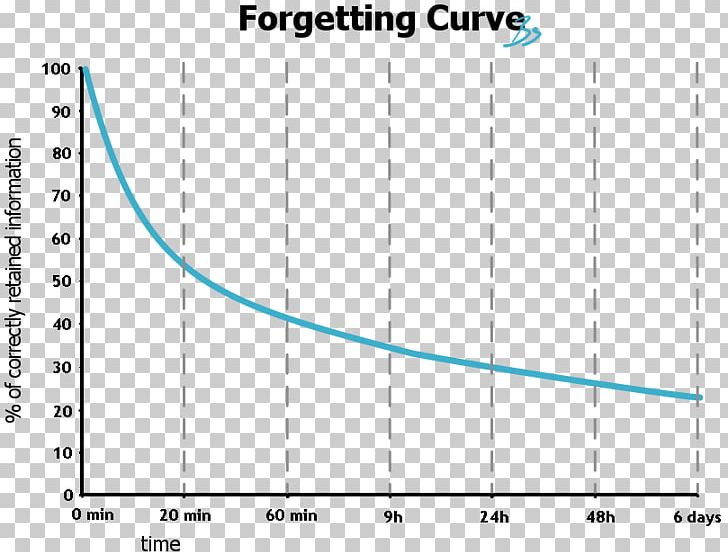
So instead, it filters and information that isn't used regularly tends to disappear. This idea was studied by psychologist Hermann Ebbinghaus, who discovered what is now called the forgetting curve.
His experiments showed that after learning something new, we forget a large portion of it very quickly unless we review it.
The pattern generally looks like this:
- strong memory right after learning
- rapid forgetting within the first 24 hours
- slower forgetting over the following days
What Spaced Repetition Actually Is
Spaced repetition is a learning method that schedules reviews at increasing intervals. Instead of reviewing information randomly or repeatedly in one session, you review it just before you're likely to forget it.
A simple example where you double the interval at each occurence might look like this:
Day 1 → learn a word
Day 2 → review
Day 4 → review
Day 8 → review
Day 16 → review
Day 32 → review
Each review strengthens the memory and increases the interval before the next review. Eventually the information becomes part of long-term memory.
It is as simple as this.
The key focus of research is the algorithm that schedules when you review information. Some researchers are developing advanced algorithms to further optimize our learning efficiency through spaced repetition, such as:
- SM-2
- FSSR (Forgetting Space Spaced Repetition)
Why This Method Works So Well
What makes spaced repetition powerful is that it combines two key learning mechanisms.
1. Timing
Reviewing right before forgetting strengthens the neural connection associated with that memory.
If you review too early, the brain doesn't need to work.
If you review too late, the memory might already be gone.
2. Active Recall
Most spaced repetition systems rely on active recall. Instead of rereading the answer, you try to retrieve it from memory.
For example:
Front: house
Back: casa
Before flipping the card, you force yourself to remember casa. That effort is what strengthens the memory.
How I Personally Use It
At first I used Anki but to be honest the app doesn't give me much appeal. It is still to this day the best app for spaced repetition, highly configurable if you want to. A lot of public decks of cards are available. I then used Migaku to review words that i "mined" in content that I watched. It is also a very good option but I regret that we can't review words when the date is not due. I currently use my own personal system.
Instead of trying to memorize huge lists of vocabulary at once, I focus on consistency.
Why It's Perfect for Language Learning
Language learning involves memorizing a huge number of small elements : vocabulary
Spaced repetition handles this extremely well because it:
- prioritizes weak memories
- reduces unnecessary repetition
- spreads learning over time
- builds long-term retention
Instead of studying everything repeatedly, the system focuses on what you're most likely to forget.
Tips
- Don't be too greedy, if you add 100 new cards per day, your review queue will explode in a week and you will lose motivation. A smaller daily number is much more sustainable.
- Try to learn as actively as possible : Looking at the answer too quickly defeats the purpose.You need to actually try to remember first.
Final Thoughts
What I like most about spaced repetition is how simple it is. You don't need complicated study methods or long sessions. Over time, knowledge accumulates almost automatically.